
Paying off debt can feel overwhelming, especially if you have multiple loans or credit card balances. Fortunately, two popular repayment strategies can help you become debt-free: the Debt Snowball and the Debt Avalanche methods.
Both approaches are effective, but they work differently. Understanding the advantages of each can help you choose the strategy that best fits your financial goals and personal motivation.
What Is the Debt Snowball Method?
The Debt Snowball method focuses on paying off your smallest debt first while making minimum payments on all other debts.
Once the smallest balance is paid off, you apply that payment to the next smallest debt, creating a “snowball” effect.
Benefits of the Debt Snowball Method
- Builds motivation through quick wins.
- Simplifies your repayment plan.
- Helps create positive financial habits.
- Keeps you motivated to continue paying off debt.
This method is often recommended for people who need psychological motivation to stay consistent.
What Is the Debt Avalanche Method?
The Debt Avalanche method prioritizes paying off the debt with the highest interest rate first while continuing minimum payments on the remaining balances.
Once the highest-interest debt is eliminated, you move to the next highest interest rate.
Benefits of the Debt Avalanche Method
- Saves more money on interest.
- Reduces the total cost of your debt.
- Can shorten your repayment timeline.
- Maximizes long-term financial efficiency.
This approach is ideal for people who want to minimize interest costs.
⸻
Debt Snowball vs Debt Avalanche: Key Differences
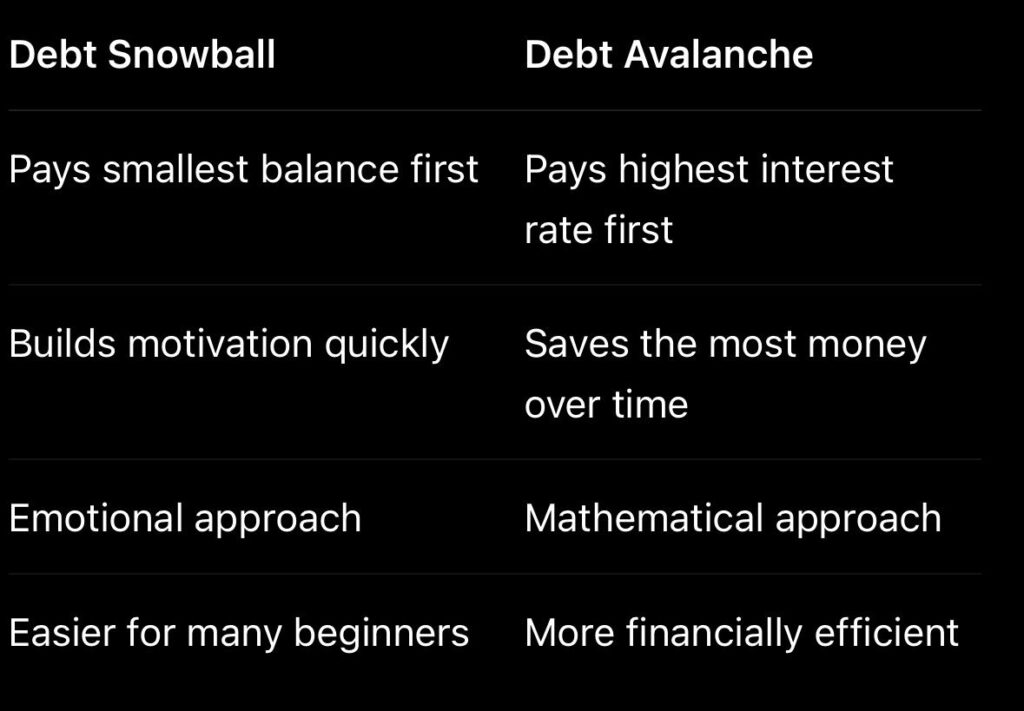
Debt Snowball Debt Avalanche
Pays smallest balance firstPays highest interest rate first
Builds motivation quickly Saves the most money over time
Emotional approach Mathematical approach
Easier for many beginners More financially efficient
Which Method Is Better?
The best strategy depends on your personality and financial situation.
Choose the Debt Snowball if you:
- Need motivation from quick results.
- Prefer seeing debts disappear one by one.
- Struggle to stay consistent.
Choose the Debt Avalanche if you:
- Want to pay less interest.
- Have high-interest credit card debt.
- Prefer the mathematically efficient approach.
Neither strategy is universally better—the best one is the one you can consistently follow.
Tips to Succeed with Either Method
Regardless of the strategy you choose:
- Create a monthly budget.
- Make payments on time.
- Avoid taking on new debt.
- Build a small emergency fund.
- Review your progress every month.
Consistency is the key to becoming debt-free.
⸻
Common Mistakes to Avoid
Many people delay their progress by making these mistakes:
- Missing monthly payments.
- Continuing to use credit cards excessively.
- Not tracking their debt balances.
- Giving up after unexpected expenses.
- Ignoring high-interest debt.
Avoiding these mistakes can help you reach financial freedom sooner.
Frequently Asked Questions
Does the Debt Snowball really work?
Yes. Many people succeed with the Debt Snowball because paying off smaller balances creates momentum and keeps them motivated.
Which method saves more money?
The Debt Avalanche usually saves more money because it reduces high-interest debt first.
Can I combine both methods?
Yes. Some people start with the Debt Snowball for motivation and later switch to the Debt Avalanche to reduce interest costs.
Final Thoughts
When comparing Debt Snowball vs Debt Avalanche, there is no one-size-fits-all answer.
If motivation keeps you moving, the Debt Snowball may be the better choice. If saving money on interest is your priority, the Debt Avalanche is often the smarter financial option.
The most important step is choosing a strategy and sticking with it consistently until you become debt-free.
- How to Pay Off Debt Faster Without Stress
- Beginner’s Guide to Personal Finance
- How to Get Out of Credit Card Debt
- How Credit Cards Really Work
Learn more about debt repayment options from the Consumer Financial Protection Bureau.
Enlace: https://www.consumerfinance.gov/